Tijou’s Hand-Forged Decorative
Ironwork for Fences, Gates, Doors, and
Railings
The legacy of Tijou’s custom hand-forged ironwork is a testament to timeless artistry and craftsmanship in architecture. Each fence, gate, door, or railing crafted in this tradition is not merely functional but a work of art that enhances its surroundings. With hand-forged techniques and elaborate designs, these decorative iron pieces unite strength with intricate beauty, offering both security and a statement of elegance. Below, we explore the heritage, craftsmanship, and applications of Tijou-style decorative ironwork in fences, gates, doors, and railings, maintaining an authoritative and architectural perspective throughout.
The Legacy of a Master Ironworker
Jean Tijou, a 17th-century French master blacksmith, set the gold standard for ornamental ironwork in England. Fleeing France as a Huguenot refugee, Tijou arrived in England in the late 1680s and quickly earned royal patronage. He became renowned for introducing the ornate Baroque ironwork style to grand English estates and palaces. Working under the reign of King William III and Queen Mary II, Tijou’s creations graced key landmarks of the era. His masterwork – the Hampton Court Palace screen – is a sprawling decorative fence of twelve highly ornate wrought-iron panels that marked the boundary of the Privy Garden. This monumental screen, completed around 1692, incorporates symbols of the British Isles (such as roses, thistles, and harps) amidst a lattice of scrolls and leaves. It took him three years of dedicated forging to complete, reflecting an uncompromising commitment to quality and detail. Tijou’s craftsmanship also adorned St. Paul’s Cathedral, Chatsworth House, Kensington Palace, and other great houses of the nobility, making his name synonymous with the finest decorative ironwork of the Baroque age.
Beyond his commissioned works, Tijou influenced generations of metal artisans through his published designs. In 1693, he produced one of Britain’s first ironwork pattern books – a folio of twenty engraved plates showcasing gates, balconies, stair railings, door grilles, and decorative panels from his projects. In its introduction, Tijou wrote that these designs were “for the use of them that will work iron in perfection and with art.” This phrase encapsulates his philosophy: ironwork should marry structural perfection with artistic flair. The wide circulation of his pattern book meant that the “Tijou style” – characterized by exuberant scrollwork, rich foliage, and symmetrical elegance – became the benchmark for decorative ironwork well into the 18th century. Today, when we refer to “Tijou’s custom hand-forged ironwork,” we evoke this heritage of masterful design and craftsmanship that continues to inspire modern blacksmiths.
Hand-Forged Baroque Craftsmanship and Design
At the heart of Tijou’s ironwork tradition is the art of hand-forging. Each component of a fence, gate, door grille, or railing is individually heated in a forge and shaped with hammer and anvil by a skilled blacksmith. This painstaking process imbues the metal with a level of detail and character that mass-produced cast iron or factory fabrication cannot match. Hand-forging also ensures exceptional strength and durability – the wrought iron bars and scrolls are fibrous and tough, capable of withstanding centuries when properly maintained. The joints in traditional ornamental ironwork are often riveted or collared rather than merely welded, allowing slight flex and added resilience. The result is an enduring structure built to bear weight and weather while retaining delicate beauty.
Each hand-forged piece is unique. Blacksmiths working in Tijou’s tradition may start from established motifs, but they tailor the composition to the specific project. This custom design approach means that a decorative railing or gate will be perfectly proportioned to its setting and can incorporate motifs that echo other architectural elements of the property. The process often begins with detailed drawings, much as Tijou created for his clients, then moves to the forge where raw iron bars are transformed into art. Patience and skill are paramount: a large ornamental gate might require hundreds of hours of labor, from hammering red-hot metal into refined curves, to chiseling subtle veins in a leaf, to fitting and finishing the assembled structure. The end product is an heirloom-quality piece of architecture – imbued with the spirit of the blacksmith and the timeless appeal of classical design.
Tijou’s Baroque Artistry
Equally important to craftsmanship is the design artistry. Tijou’s designs exemplify Baroque exuberance, carefully balanced with harmony and proportion so that the ironwork complements its architectural setting. Working in an era fascinated by classical motifs and natural forms, Tijou and his contemporaries filled their ironwork with dynamic shapes and rich ornament. Some key design features of this style include:
Graceful Scrollwork
Flowing C- and S-curved scrolls form the framework of many pieces. These sweeping curves interweave symmetrically, creating rhythmic patterns that draw the eye across a gate or railing. The scrolls often branch outward or mirror each other in pairs, establishing an elegant sense of order amid the complexity.
Floral and Foliage Motifs
Decorative ironwork in Tijou’s style is lush with botanical details. Acanthus leaves—a classical symbol of longevity and quality—appear frequently, forged into curling three-dimensional ornaments that sprout from the metal framework. Rosettes and blossoms are used as focal accents, often placed at the intersections of scrolls or at the center of panels. These natural motifs soften the metal’s hardness and lend a lively, organic character to the design.
Heraldic and Mythical Elements
In grand installations, the ironwork became a canvas for symbolism and status. Tijou often incorporated heraldic emblems or national symbols into his pieces. For example, royal monograms, crowns, eagles, and even mythical creatures like lions or unicorns (supporters from coats of arms) might be found perched atop an elaborate gate or woven into a grille pattern. These elements personalized the work for a patron and tied it to the identity of a place or family.
Gilding and Finishing Touches
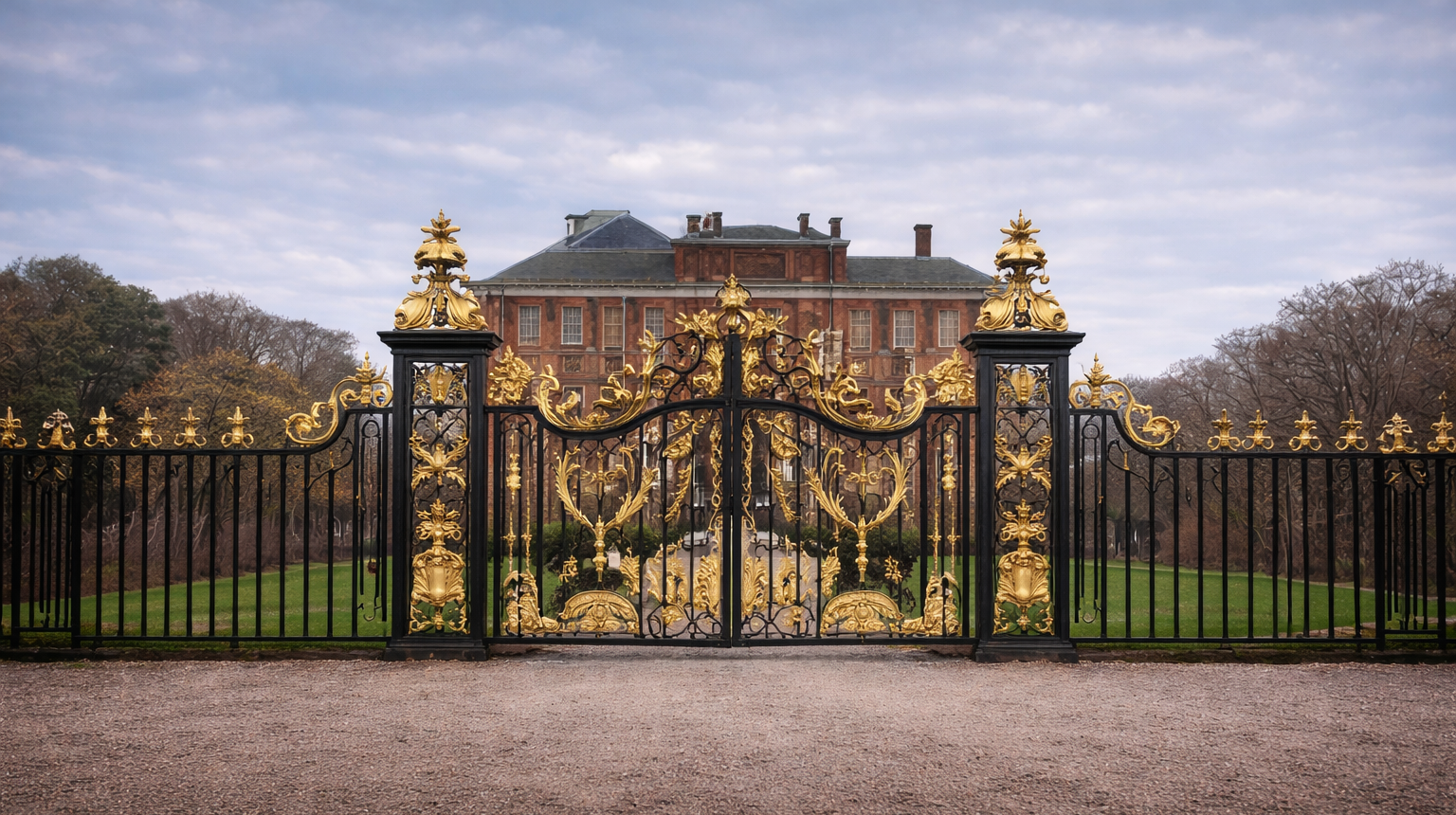
A hallmark of high Baroque ironwork is the contrast of dark wrought iron with gleaming highlights. Tijou’s most famous gates and screens were originally gilded — delicate gold leaf applied to select details like leaf tips, crests, or finials. The gold accents catch the light, emphasizing the craftsmanship and imparting a luxurious aura. Even when not gilded, the ironwork was often painted (traditionally in black or a dark green) to protect against rust and to contrast with stone architecture. The interplay of light on polished or painted iron surfaces, combined with the depth of the three-dimensional forging, gives these pieces a dynamic appearance throughout the day.
Tijou’s Baroque Artistry
-
Gilding and Finishing Touches: A hallmark of high Baroque ironwork is the contrast of dark wrought iron with gleaming highlights. Tijou’s most famous gates and screens were originally gilded — delicate gold leaf applied to select details like leaf tips, crests, or finials. The gold accents catch the light, emphasizing the craftsmanship and imparting a luxurious aura. Even when not gilded, the ironwork was often painted (traditionally in black or a dark green) to protect against rust and to contrast with stone architecture. The interplay of light on polished or painted iron surfaces, combined with the depth of the three-dimensional forging, gives these pieces a dynamic appearance throughout the day.
Ornamental Iron Fences and Railings
Decorative iron fences and railings provide a graceful yet secure framework for gardens, terraces, balconies, and stairways. In the hands of a master like Tijou, these everyday architectural boundaries became extravagant displays of pattern and craft. An iron fence or railing serves as the linear connective tissue around a property or along a staircase, and Tijou-style work ensures this connective element is anything but ordinary.
Garden and Perimeter Fences:
A wrought-iron fence defines the edge of an estate or garden with an open, airy elegance, unlike the solidity of a wall. Through its repeating motifs, it establishes a visual rhythm along the property line. Tijou’s Hampton Court screen is a prime example of a fence elevated to high art: a sequence of ornamental panels, each unique yet harmonious, linked by simpler railing sections to form a continuous boundary. The openness of the ironwork allows glimpses of the landscape beyond, while the decorative features provide aesthetic delight up close. Custom hand-forged fences often incorporate vertical pickets topped with finials (spearpoints, fleur-de-lis, or other shapes), interspersed with scrollwork panels or medallions at intervals. This creates a balance between security and decoration. The finials deter intruders, but also act as design accents that create an interesting silhouette against the sky. Along the lower portion, additional horizontal bars or smaller scroll patterns might be included for stability and visual completeness. The overall effect is a fence that not only protects the property but also enhances its curb appeal, echoing design themes found in the main building or garden design.
Railings and Balustrades:
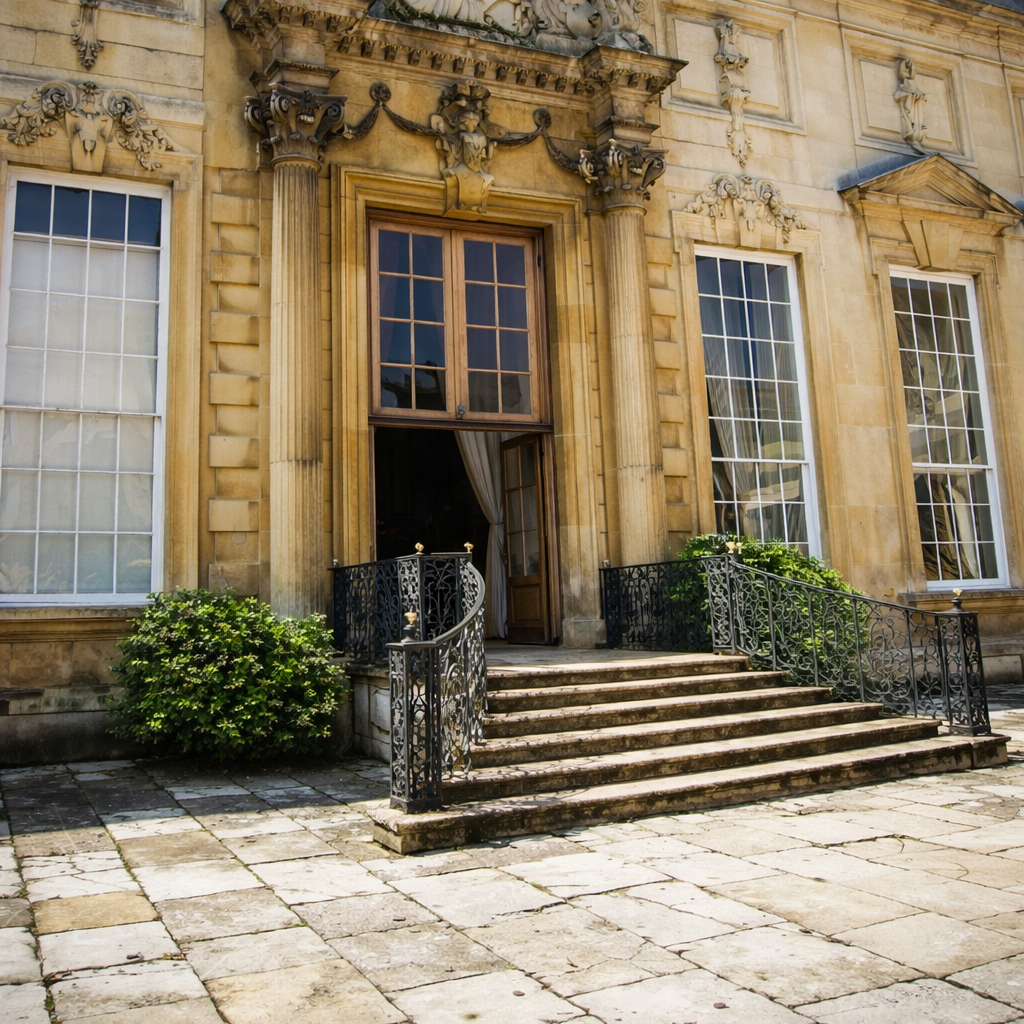
Iron railings are crucial safety features on balconies, staircases, and terraces – but in the Tijou tradition, they are crafted to be beautiful focal points in their own right. Interior stair balustrades forged in the late 17th and early 18th centuries often mirrored the style of the building’s exterior ironwork. For instance, Tijou contributed to an elegant stair railing at Chatsworth House: a cascade of wrought iron following the sweep of the marble stairs, ornamented with scrolls, leaves, and small gilded details that complement the stately interiors. A well-designed railing integrates with the architecture; the rhythm of its balusters (vertical members) and the curve of its handrail should flow naturally from the building’s form. Handforged railings can be tailored with a denser pattern or additional newel post ornaments in areas where a visual anchor is needed (such as landings or the end of a stair). On exterior balconies or verandas, decorative iron railings offer both safety and an opportunity to introduce art into the façade. They can be relatively low and horizontal, yet still showcase repeating scroll sequences, floral motifs, and perhaps initials or emblems in the center of each balcony span. When sunlight passes through such railings, it casts lace-like shadows on adjacent surfaces – an ever-changing mural of the design. This interplay of light and shadow, solid and void, is a unique quality of ornamental iron fences and railings that adds an extra dimension to the architecture.
Whether used as a perimeter fence along a driveway or as a railing on a grand staircase, Tijoustyle ironwork is engineered for longevity. Many original pieces from the 1700s survive today, a bit weathered but still structurally sound, owing to the high-quality wrought iron and periodic
restoration. Modern reproductions and custom projects use similar traditional materials – often mild steel or true wrought iron when available – and traditional joinery techniques to ensure that new fences and railings will endure for generations. In design, a custom decorative fence or railing can either faithfully replicate historical patterns or creatively adapt them. For example, a homeowner might choose an acanthus-and-scroll motif from one of Tijou’s plates but incorporate a contemporary monogram or a regional emblem into the sequence, making it personal yet historically grounded. In any case, ornamental iron fences and railings serve as the elegant “frame” to the architecture they surround, providing safety and privacy without feeling oppressive, and adding a touch of artistry to lines that would otherwise be purely utilitarian.
Tijou’s Baroque Artistry
Equally important to craftsmanship is the design artistry. Tijou’s designs exemplify Baroque exuberance, carefully balanced with harmony and proportion so that the ironwork complements its architectural setting. Working in an era fascinated by classical motifs and natural forms, Tijou and his contemporaries filled their ironwork with dynamic shapes and rich ornament. Some key design features of this style include:
Security with Elegance
One of the historical advantages of incorporating iron into doors and windows was improved security without sacrificing aesthetics. A wrought iron gate across a glass patio door, for instance, allows the door to be left open for a breeze while the ironwork keeps the home secure. In an era before alarm systems, these measures were both necessary and appreciated for their beauty. Modern custom iron doors continue this tradition: you might find elaborate full-length iron doors at the entrance of a Mediterranean-inspired villa or a luxury wine cellar, their designs inspired by Baroque originals. Even in contemporary architecture, where clean lines dominate, a touch of hand-forged iron at the door can introduce an artisanal contrast and point of interest. Because each piece is custom, the design can be adapted to fit both
traditional and modern aesthetics; the unifying aspect is the evident hand-crafted quality that instantly conveys solidity and luxury.
In summary, decorative ironwork for doors and openings provides an inviting yet secure threshold. It demonstrates that functional elements—be it a simple window grill or a grand front door—need not be devoid of artistic merit. On the contrary, following Tijou’s ethos, the entrance of a home or building is an opportunity to showcase craftsmanship and make a lasting impression. From the small-scale charm of a wrought iron door knocker to the sweeping drama of a transom grill, these details enrich the architectural composition and echo the grandeur seen in larger ironwork pieces outside.
Door Grilles and Panels
In grand Baroque and Rococo architecture, it became fashionable to include transoms and sidelights around doors filled with intricate iron screens. Jean Tijou’s contemporaries and followers produced fanlights (semi-circular or elliptical windows above a door) with radiating iron tracery and scrolls, or small vestibule gates that stand just in front of an entry door. These features allowed light into entry halls while keeping them secure, and they provided another canvas for iron artistry. A decorative door grille might echo the patterns found
on exterior gates or fence railings, creating a unified design language from the moment one approaches the building. For example, if the exterior gate features an acanthus leaf motif and a monogram, the matching motif could appear in the iron grill of the home’s front door or in the balcony railing above. Hand-forged iron panels can also be set directly into wooden doors. In some historic mansions, double doors have upper halves that are essentially small iron gates – a lattice of wrought iron in place of or over the glass. These are both beautiful and practical: they allow ventilation and visibility when the solid door behind is open, and when closed they present an imposing decorative front.
Hardware and Accents
Even when a door is primarily wood or another material, ironwork often plays a critical accent role. The Tijou style of ironwork extends to elements like strap hinges, handles, knockers, and door pulls. Rather than plain utility pieces, these components are crafted as adornments. Long strap hinges on a heavy wooden door might be forged with leafy
termini or scroll patterns along their length, turning a basic hinge into a horizontal ornamental feature. Central door knockers could take the shape of a roaring lion’s head (a symbol of guardianship) gripping a ring, or a delicate foliate wreath – designs that were popular in the 17th and 18th centuries and remain charming today. Such details add to the character of an entryway and again tie into the broader ironwork scheme of the property.
Grand Entrance Gates
Perhaps the most impressive expression of decorative ironwork is the grand entrance gate. Gates have always been symbolic in architecture – they represent the threshold between public and private space and often form a visitor’s first impression of a property. Tijou and his fellow
Baroque ironworkers approached gate design with a flair befitting this importance. The result: gates that are as much ceremonial sculptures as they are security features.
Architectural Presence:
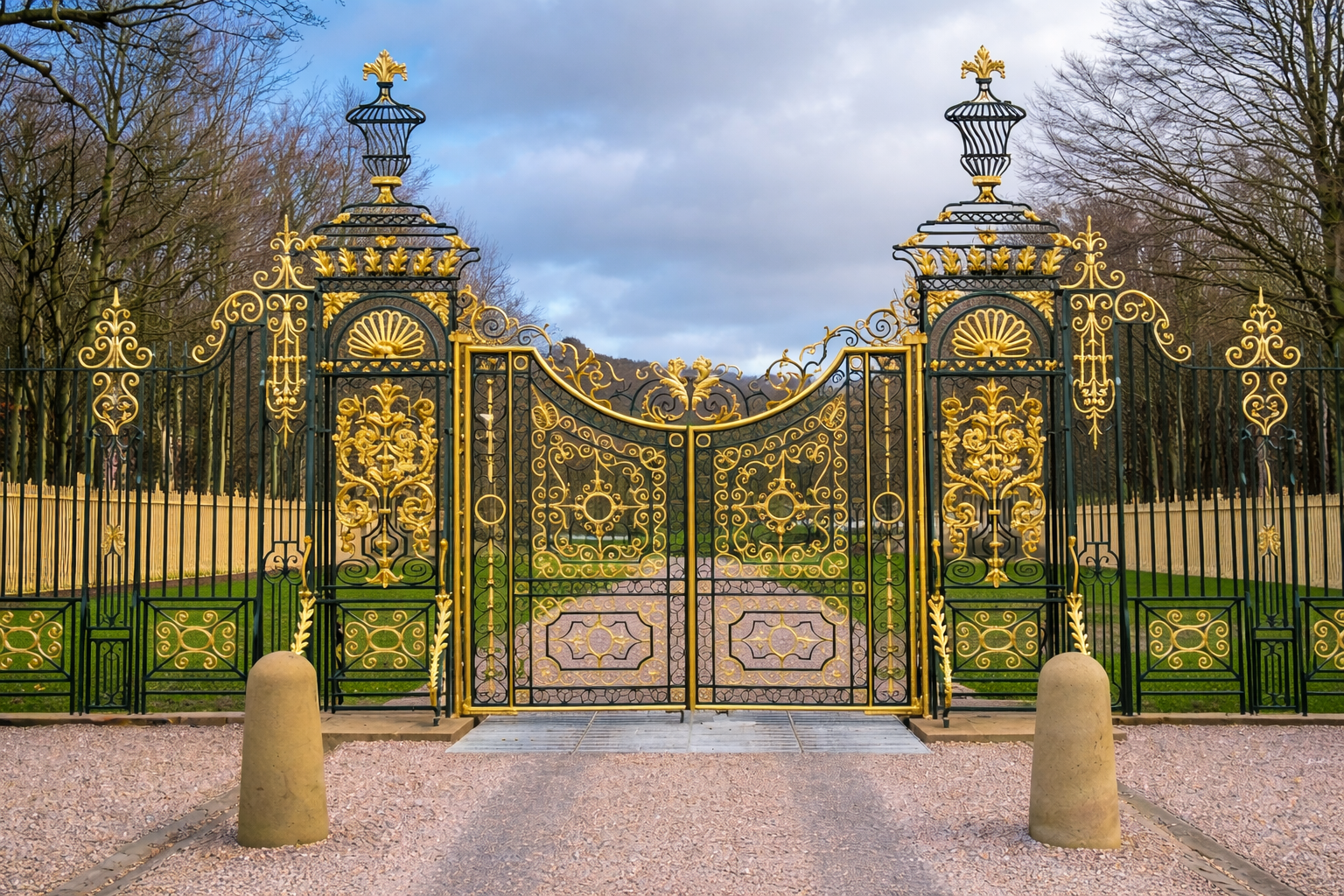
Set between masonry pillars or atop a sweeping driveway, it stands as a centerpiece of the façade. In Tijou’s portfolio, the great gates of Burghley House and Chatsworth are legendary examples. These gates tower in height and are broad enough for carriages, composed of double doors (two swinging leaves) that meet at the center. Above the meeting point, an elaborate overthrow often spans between the gateposts – this is a decorative crest or arch crowning the gate. Tijou-style overthrows are typically bursting with scrolls, foliage, and a prominent central emblem such as a coat of arms or an eagle with outstretched wings. The overthrow serves both to unify the two halves of the gate visually and to extend its presence upward, sometimes nearly doubling the gate’s height in ornament alone. Flanking the main gates, smaller side panels or pedestrian gates might mirror the design, ensuring a cohesive look across the entrance.
Design and Detailing:
The structure of a hand-forged gate must be robust – large gates are
expected to swing smoothly and withstand both usage and the elements. Thus, thick wrought iron bars form the framework: vertical stiles and horizontal rails create a sturdy lattice on which decorative elements are affixed. Tijou’s gates often featured multiple horizontal divisions: a lower section perhaps filled with tighter scrollwork or small balusters to deter small animals, a central field with open ornate design for visual transparency, and an upper section rising into the curvilinear silhouette of the overthrow. Heavy hinge straps, often themselves embellished with scroll-ends or leaf motifs, connect the gates to iron gudgeons anchored in the stone piers. The locking mechanism, while utilitarian, might be concealed or integrated into the design (for example, a decorative central cartouche might actually house the lock). No opportunity was wasted to add ornament—finials line the top of the gate’s bars, each finial hand-forged into shapes like flames, fleurs-de-lis, spears, or pineapples, providing a rhythmic crown. Mid-level, one might find a row of medallions or rings interlinked with flowing ribbons of iron. The bottom could be bordered by a scrolling leaf frieze echoing the garden foliage beyond.
Symbolism and Grandeur:
Just as with fences and railings, gates in the Tijou style often carried personal or symbolic significance. Noble families would commission their crests, mottos, or initials to be worked into the gate’s central motif. An entrance gate thereby became a heraldic display, broadcasting lineage and pride to any approaching visitor. Even in modern custom gates that emulate this style, clients sometimes choose to include meaningful symbols—be it a family monogram, a logo, or a motif that reflects the property’s name (for instance, a rose for “Rosewood Estate”). These details, when sculpted by an expert blacksmith, blend seamlessly into the artistic composition, serving as a unique signature of the gate’s owner.Standing before an ornate hand-forged gate, one cannot help but feel the intended impression: a mix of awe and welcome. The scale, the complexity of the iron lacework, and the interplay with the surrounding architecture (such as matching the gate’s design to the iron balconies of the manor, or to carvings in the stone entryway) all contribute to a sense of cohesive grandeur. Importantly, despite their lavish appearance, these gates are built for function; many have operated for centuries. The integrity of traditional forging means that hinges remain strong, panels remain true, and with occasional care, a Baroque iron gate can continue to swing open effortlessly for generations. In contemporary installations, modern methods like hidden ballbearings in the hinges or protective coatings may be employed, but always in a manner that preserves the historic character. A grand wrought-iron gate is an investment in both security and artistry, increasing a property’s prestige while providing a durable portal that stands at the ready to welcome or guard as needed.
Timeless Architectural Artistry
Tijou’s custom hand-forged decorative ironwork for fences, gates, doors, and railings embodies a timeless architectural artistry. What began as Jean Tijou’s personal quest to “work iron in perfection and with artes to be sought after in both historical restorations and new custom homes.” has evolved into a broader design language appreciated across centuries. The enduring appeal of this ironwork lies in its dual nature: it is at once utilitarian and highly artistic. A wrought-iron gate locks and protects, yet it greets visitors with intricate beauty. A railing provides support and safety, yet it delights the eye with patterns of scrolls and leaves. An ornamental door grille deters intruders, yet it also inspires with its handcrafted detail. This fusion of form and function is the hallmark of great architectural elements, and it explains why Tijoustyle ironwork continu
The architectural tone of these iron pieces is one of stately elegance. Whether accenting a Baroque Revival mansion or adding old-world charm to a modern residence, they carry with them the gravitas of history and the bespoke quality of fine art. Importantly, they connect the present to the past: a new hand-forged fence made today still follows techniques from centuries ago, and a viewer admiring it experiences the same sense of awe that visitors to Hampton Court
or Chatsworth might have felt in 1700. This continuity of craft is a living tradition. Modern blacksmith artisans, often trained in classical methods, take up the hammer to create pieces inspired by Tijou – or to carefully restore the master’s surviving works. In doing so, they ensure
that the knowledge and aesthetic sensibilities are passed on. It is not uncommon to see contemporary ironwork studios referencing Tijou’s patterns or using his published designs as a base for custom projects, a testament to the lasting relevance of his vision.
In a world where many building materials are mass-produced, the choice to include custom hand-forged ironwork is a commitment to authenticity and character. Each scroll, twist, and leaf carries the imprint of human hands and the subtle variations that come with true artisanal creation. This yields an outcome that feels rich and alive, in contrast to sterile factory-made components. Clients and architects who incorporate Tijou-style ironwork often remark on how it becomes the “jewel” of the property – a conversation piece that garners admiration. Sunlightglinting off a gilded gate, shadows of a lacy railing dancing on a terrace, the solid feel of an ornate iron handle – these sensory experiences elevate daily life.Ultimately, Tijou’s legacy in decorative ironwork teaches us that even the heaviest of materials can be fashioned into objects of delicate beauty. Through skilled craftsmanship and inspired design, iron is made to appear almost weightless, taking on the fluid curves of vines and the airy openness of lace. Fences, gates, doors, and railings that follow this tradition do more than serve a function; they tell a story – of heritage, of artistry, and of the harmonious blend of architecture and craft. As we admire or pass through these hand-forged creations, we become part of that story, connected by the enduring allure of decorative ironwork that truly transcends time.